Schema Markup for GEO: A Practical Guide to Structured Data for AI Search

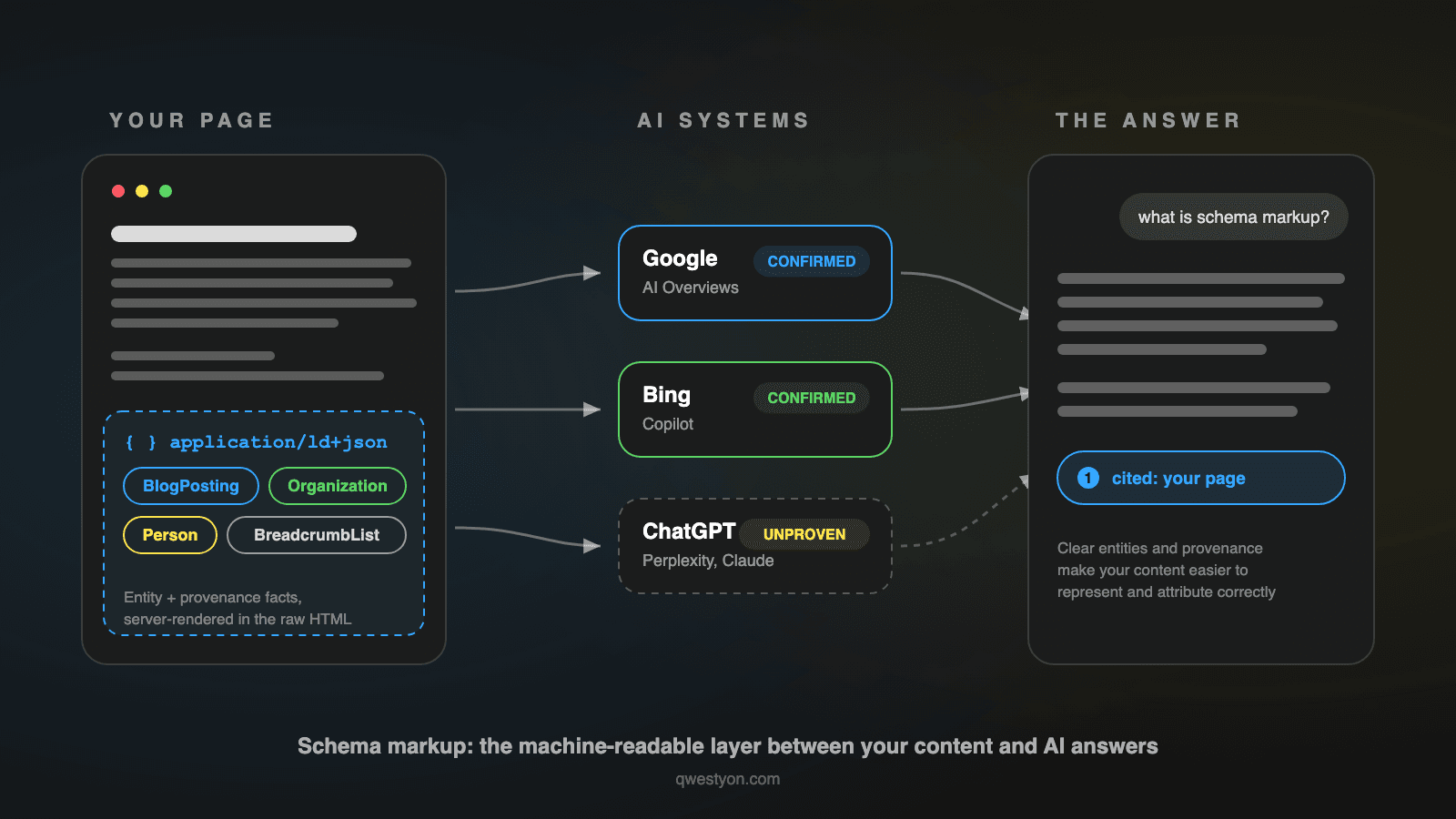
Does schema markup help you show up in AI search? Here is the short, honest answer. For Google AI Overviews and Bing Copilot: yes, both companies have said so on the record. For ChatGPT, Claude and Perplexity: unproven, and the one serious independent study on the question found no correlation between schema coverage and citations. Schema markup is infrastructure. It makes your content easier for machines to understand and harder to misrepresent, and it costs little to do well. It is not a magic citation button, and anyone selling it as one is guessing.
I run a marketing agency and we implement schema on our own site and for clients, so I wanted better evidence than the recycled statistics that dominate this topic. In July 2026 we audited 60 pages ranking for schema and AI-search queries to see what the winners actually do. The results are further down, and the raw data is free to download.
What Is Schema Markup?
Schema markup is a standardised vocabulary of tags, published at schema.org, that you add to your web pages so machines can interpret content type and entity relationships precisely rather than inferring them from natural language.
HTML tells browsers how to display content. Schema tells machines what content means.
Schema.org launched on 2 June 2011 as a joint project between Google, Microsoft and Yahoo, with Yandex joining later that year. Schema.org's own documentation puts adoption at over 45 million web domains. It is the closest thing the web has to a shared language for machine-readable meaning.
Without schema, an AI system encountering a page about a marketing agency has to guess. Is this a business? A blog? Who wrote it? When was it published? Inference is error-prone. Schema removes the guesswork for the facts that matter.
The standard implementation format is JSON-LD, a script block in your HTML that describes the page in a clean, structured object. More on formats below.
How Schema Options Differ for SEO vs GEO
The schema.org vocabulary is the same whichever acronym you optimise for. What changes is which types earn their keep, and why.
For traditional SEO, schema has always been a features play. You add Product markup to get price and rating stars, FAQPage to get dropdowns, and so on. Google reads it, checks eligibility, and maybe decorates your listing. When Google deprecates a rich result, as it did with FAQ and HowTo in August 2023, that schema type loses most of its SEO value overnight.
For Generative Engine Optimisation, the same vocabulary is doing a different job. AI systems synthesising an answer need to resolve entities: which company is this, which person wrote this, is this the same organisation mentioned on LinkedIn and Companies House. Schema is the cheapest reliable way to hand them those facts. The value concentrates in entity and provenance types, the unglamorous ones: Organization, Person, Article with real author and date fields, BreadcrumbList for site structure.
Schema markup: the SEO job vs the GEO job
Traditional SEO
- Win rich result features where they still exist (Product, Review, Breadcrumb)
- Help Google classify page type and topic
- Signal freshness via dateModified
- Improve crawl efficiency on large sites
- Value tracks rich result support, which Google can withdraw
GEO / AI search
- Declare entities precisely: who you are, who wrote this, what the page is
- Provide provenance AI systems can check: authorship, dates, publisher
- Reduce the odds of AI misdescribing your brand or offer
- Connect pages into a coherent entity graph via @id references
- Value confirmed for Google AI Overviews and Bing Copilot; unproven elsewhere
Here is the same comparison at the level of individual types, with an honest note on the evidence for each.
| Schema type | SEO value today | GEO value today | Evidence |
|---|---|---|---|
| Organization | Knowledge panel support, sitelinks context | Entity identity, brand fact-checking | Confirmed useful by Google's structured data docs |
| Article / BlogPosting | Article rich results, Top Stories eligibility | Authorship and freshness provenance | Confirmed by Google; on 67% of pages in our audit |
| Person | Modest | Author E-E-A-T and entity resolution | Directionally supported; on 35% of audited pages |
| BreadcrumbList | Breadcrumb display in results | Site hierarchy context | Confirmed by Google; on 60% of audited pages |
| FAQPage | Rich results deprecated for most sites (Aug 2023) | Clean Q&A pairs machines can lift | Unproven for citations; on 10% of audited pages |
| HowTo | Rich results dropped (2023) | Theoretical extraction benefit | No confirmation; on 0% of audited pages |
| Product + AggregateRating | Price and star snippets still live | Structured facts for shopping-type answers | Confirmed for Google Shopping surfaces |
| LocalBusiness | Local pack and maps data | Address and service-area facts for local AI queries | Confirmed via Google Business ecosystem |
If you only take one thing from this table: the types everyone recommends for "AI SEO" are the ones with the weakest evidence, and the boring entity types carry the confirmed value.
Does Schema Markup Help You Appear in Google AI Overviews?
This is the question behind most searches that land on this page, so let us deal with it properly.
Google has answered it, more directly than people realise. In April 2025 Google stated that structured data gives pages an advantage in AI-powered search features because it is efficient, precise and easy for machines to process. Search Engine Land's analysis of AI Overviews and structured data, drawing on Similarweb data, found pages with structured data appearing more often inside AI Overviews and rich formats.
There is an important mechanical point underneath this. AI Overviews are built on top of Google's ordinary index and ranking systems. A page that cannot rank in the classic sense rarely gets cited in an AI Overview. So schema helps the way good technical SEO has always helped: it improves Google's confidence in what your page is, which supports the ranking that citation depends on. Our own data below makes the same point from the other direction: pages in the top three positions for AI-search queries carry noticeably more schema than pages ranked four to ten.
What schema will not do is compensate for content Google has no other reason to surface. Structured data is a clarity layer over your content, and clarity only helps if there is something worth being clear about.
Schema Markup for LLMs: What ChatGPT, Copilot and Perplexity Actually Use
Away from Google, the picture splits into one confirmation and a lot of silence.
The confirmation is Microsoft. In March 2025, Bing's Fabrice Canel stated that schema markup helps Microsoft's LLMs understand content, which covers Bing Copilot. Since Bing's index also feeds ChatGPT's browsing in various configurations, this is the strongest indirect argument that schema reaches OpenAI's products too.
Everything else is inference. OpenAI, Anthropic and Perplexity have not confirmed parsing schema markup. And the best independent evidence points the other way: a December 2024 Search Atlas study analysed citation behaviour across OpenAI, Gemini and Perplexity and found no correlation between schema coverage and citation rates. Their conclusion is the most useful sentence written on this subject: schema amplifies strong content but does not rescue weak content.
Two technical realities explain the gap. Most LLM retrieval pipelines convert web pages to plain text or markdown before the model reads them, and that conversion can drop script tags, JSON-LD included. Other pipelines feed the raw HTML through the tokeniser, in which case the model sees the text inside your JSON-LD but does not parse it as structured data. Either way, the neat machine-readable graph you built may reach the model as ordinary words, or not at all.
You will often see a related claim that structured data makes GPT-4 three times more accurate, quoting a jump from 16% to 54%. The number is real but it is not about websites. It comes from a data.world benchmark on question answering over enterprise SQL databases, where a knowledge graph representation lifted GPT-4's accuracy from 16.7% to 54.2%. It is good evidence that structured representations help LLMs reason. It says nothing about JSON-LD on your blog, and citing it as if it does is how this topic got so muddy.
Our advice, and what we do ourselves: implement schema for the confirmed platforms and for entity clarity, keep your visible content extractable on its own merits, and treat any promise of guaranteed LLM citations with suspicion. If getting cited by chatbots is the goal, our guide to getting cited in ChatGPT covers the levers with better evidence behind them.
We Audited 60 Pages Ranking for AI-Search Queries. Here Is What They Actually Use.
Most statistics in this niche trace back to nobody. We wanted numbers we could stand behind, so in July 2026 we pulled the top ten web results for ten schema-and-AI-search queries (the same queries this page competes for), collected 63 unique pages, and crawled the 60 that still resolved. A script extracted every JSON-LD block, flattened the graphs, and tallied schema types per page.
Headline findings from the audit
92%
Top-3 pages with JSON-LD
vs 75% for positions 4-10. Qwestyon audit, July 2026, n=60
5 vs 2
Median schema types, top 3 vs rest
Distinct core types per page. Qwestyon audit, July 2026
10%
Pages using FAQPage
The most-hyped AI schema type. Qwestyon audit, July 2026
The type-by-type breakdown across all 60 pages:
| Schema type | Share of ranking pages |
|---|---|
| Article / BlogPosting | 66.7% |
| BreadcrumbList | 60% |
| Organization | 53.3% |
| WebSite | 46.7% |
| WebPage | 40% |
| Person | 35% |
| FAQPage | 10% |
| Product | 3.3% |
| HowTo | 0% |
Three things in this data changed how I think about schema for GEO.
HowTo is dead in practice, not just in policy. Google dropped HowTo rich results in 2023, and apparently everyone noticed: not one of 60 pages ranking for AI-search queries uses it. Every guide still recommending HowTo as a top AI schema type (including, until this update, ours) is recommending something the winners do not bother with.
FAQPage is rare among winners. One page in ten. If FAQPage markup were the 3x citation multiplier the recycled statistics claim, you would expect the pages competing hardest on this exact topic to be saturated with it. They are not. The pages ranking top three used FAQPage slightly more (12.5%) than positions four to ten (8.3%), which is a long way from a smoking gun.
What top pages do have is layered core types. The median top-three page carries five distinct schema types, against two for positions four to ten, and 92% of top-three pages have valid JSON-LD. That is a correlation, not a causal finding: sites that rank well tend to be technically mature in lots of ways at once. But it tells you what the table stakes look like.
Two smaller findings worth knowing: 61.7% of ranking pages expose dateModified in their schema, and only 3.3% had JSON-LD that failed to parse. The "silently broken schema" problem is real but rarer than the validator-tool marketing suggests.
Which Schema Format Should You Use?
There are three formats for implementing schema markup: JSON-LD, Microdata and RDFa. In practice the choice is straightforward, and in our audit only 23% of ranking pages still carried Microdata attributes, usually as theme leftovers alongside JSON-LD.
JSON-LD vs Microdata and RDFa
JSON-LD (recommended)
- Script block in the head, completely separate from HTML content
- Easy to add, update and maintain without touching page markup
- Google's explicitly recommended format since 2016
- Can be server-side rendered or injected via CMS
- Readable and validatable as a standalone text block
Microdata and RDFa (legacy)
- Attributes embedded directly inside HTML elements
- Tightly coupled to content, so template changes break schema
- Harder to debug without rendering the full page
- Still valid and parsed, but adds maintenance overhead
- No benefit over JSON-LD for new implementations
JSON-LD lives in a <script type="application/ld+json"> block, usually in the <head>. It never touches your visible HTML, so updating schema cannot break your layout. You can audit it in seconds, version-control it cleanly, and test it without loading a browser.
One caveat that matters for GEO specifically: if your JSON-LD is injected client-side by JavaScript, Google will usually see it after rendering, but AI crawlers like GPTBot generally do not execute JavaScript. Server-render your schema. If it is not in the raw HTML response, for many AI systems it does not exist.
The 8 Schema Types That Matter Most for AI Visibility
Ranked by a blend of confirmed platform support and what our audit found ranking pages actually using. Not all of these will apply to every site.
1. Organization
Organization schema establishes your entity identity across the site: name, URL, logo, social profiles and contact details, packaged as a machine-readable declaration.
Every AI system that encounters your content can cross-reference this entity data. Without it, machines infer who you are from context, and inference is where brand misdescriptions come from. This is the schema type most directly connected to how AI systems talk about your company.
Implement it once, in your global template, so it appears on every page. Use @id so your Article and WebPage blocks can reference the same Organization node rather than redeclaring it.
2. Article / BlogPosting
Article schema (or its subtype BlogPosting) marks editorial content with headline, publication date, dateModified, author and publisher. These fields are the provenance layer: they are how machines attribute authorship and judge freshness.
dateModified deserves particular care. In our audit, 61.7% of ranking pages exposed it. A page with a three-year-old datePublished and no dateModified reads as unmaintained. Update the field when you genuinely update the content, and only then; nobody is impressed by a dateModified that bumps weekly while the content never changes.
3. BreadcrumbList
BreadcrumbList defines the navigation path to the current page. It sat on 60% of the pages in our audit, and it is one of the simplest types to implement. It gives machines your site's topical hierarchy, which supports both classic breadcrumb display and the entity coherence that makes AI systems more confident about what your pages are.
4. Person
The quiet riser of the group. Person schema identifies authors with names, roles and profile links, ideally with sameAs pointing at LinkedIn or other verifiable profiles. A third of audited pages carry it, and it lines up with the direction Google has pushed for years: content attributed to identifiable, credible humans. For GEO it serves entity resolution, connecting "the Adam Rodell who wrote this" to a real professional profile rather than a string of characters.
5. FAQPage
Here is the honest version, which you will not find in most guides. Google deprecated FAQ rich results for all but well-known health and government sites in August 2023, so the classic SEO payoff is gone. The AI payoff is unproven: FAQPage appeared on only 10% of pages in our audit, and the Search Atlas study found no citation correlation.
So why does this page still use it? Because the marginal cost is near zero when you already have a genuine FAQ section, and clean question-and-answer pairs are a reasonable bet for machine extraction even without hard proof. That is the correct level of conviction: cheap bet, not strategy. Write answers that stand alone ("Our standard turnaround is 5 to 10 business days") rather than stubs ("Contact us to find out").
6. HowTo
Zero of 60 ranking pages use HowTo. Google dropped HowTo rich results in 2023. We keep it in this list only to tell you not to prioritise it. If you publish genuinely procedural content, well-structured HTML with numbered steps gives extraction systems what they need; the markup adds little on current evidence.
7. LocalBusiness
For any business with a physical location or service area, LocalBusiness schema (or a specific subtype like ProfessionalService or MedicalBusiness) supplies the structured address, hours and geo data that local queries lean on, including voice and AI-assisted "near me" lookups. The more specific the subtype, the more semantic information you hand over.
8. Product + AggregateRating
For pages describing products with real ratings, Product and AggregateRating still earn price and star treatment in classic results and feed shopping-type AI answers. One warning: never implement AggregateRating without genuine, verifiable reviews. Fabricated ratings are a spam policy violation with real penalty risk.
JSON-LD Code Examples You Can Copy and Adapt
The fastest way to learn schema implementation is from working examples. These blocks are production-ready; swap the placeholder values for your own content.
BlogPosting (for blog articles):
{
  "@context": "https://schema.org",
  "@type": "BlogPosting",
  "headline": "Schema Markup for GEO: A Practical Guide to Structured Data for AI Search",
  "description": "An evidence-based guide to schema markup for AI search, with audit data and working JSON-LD examples.",
  "image": "https://www.yourdomain.com/images/schema-markup-geo-guide.jpg",
  "datePublished": "2026-04-21",
  "dateModified": "2026-07-05",
  "author": {
    "@type": "Person",
    "name": "Adam Rodell",
    "url": "https://www.yourdomain.com/about",
    "sameAs": ["https://www.linkedin.com/in/your-profile"]
  },
  "publisher": {
    "@type": "Organization",
    "name": "Qwestyon",
    "logo": {
      "@type": "ImageObject",
      "url": "https://www.yourdomain.com/logo.png"
    }
  },
  "mainEntityOfPage": {
    "@type": "WebPage",
    "@id": "https://www.yourdomain.com/blog/schema-markup-for-geo"
  }
}
FAQPage (write answers that stand alone):
{
  "@context": "https://schema.org",
  "@type": "FAQPage",
  "mainEntity": [
    {
      "@type": "Question",
      "name": "Which schema types matter most for AI search visibility?",
      "acceptedAnswer": {
        "@type": "Answer",
        "text": "Core entity types carry the confirmed value: Organization, Article or BlogPosting with real author and date fields, BreadcrumbList and Person. In a July 2026 audit of 60 pages ranking for AI-search queries, top-three results carried a median of five schema types."
      }
    },
    {
      "@type": "Question",
      "name": "What is the difference between JSON-LD, Microdata, and RDFa?",
      "acceptedAnswer": {
        "@type": "Answer",
        "text": "JSON-LD is a script block in the page head, separate from the HTML content, and it is Google's recommended format. Microdata embeds attributes into HTML elements. RDFa is an older extension standard. JSON-LD is the clear choice for new work."
      }
    }
  ]
}
Organization (sitewide, added via your global head template):
{
  "@context": "https://schema.org",
  "@type": "Organization",
  "name": "Qwestyon",
  "url": "https://www.yourdomain.com",
  "logo": "https://www.yourdomain.com/logo.png",
  "description": "A performance marketing agency specialising in paid search, paid social, and Generative Engine Optimisation (GEO).",
  "sameAs": [
    "https://www.linkedin.com/company/qwestyon",
    "https://twitter.com/qwestyon"
  ],
  "contactPoint": {
    "@type": "ContactPoint",
    "contactType": "customer service",
    "url": "https://www.yourdomain.com/contact"
  }
}
The Schema Layering Strategy
You will see claims that layering three to four schema types doubles your AI citations. We could not find a source for that number that survives contact, so here is the version the evidence supports.
Layering complementary types builds a small knowledge graph of your page: the article, its author, its publisher, and where it sits in the site. Each type answers a different machine question, and connected together via @id references they corroborate each other. That is the theoretical case. The empirical observation from our audit is that top-three pages carry a median of five distinct types against two for positions four to ten. Correlation, not causation, but the direction is consistent.
The key word is complementary. Five copies of Article schema do nothing. One coherent graph does:
SINGLE SCHEMA
─────────────────────────────────────────────
Article ──────────────────────────────► One machine-readable fact set

LAYERED SCHEMA
─────────────────────────────────────────────
BlogPosting
  └─ publisher → Organization ─────────► Entity trust layer
  └─ author → Person ──────────────────► Attribution layer

FAQPage
  └─ Question / Answer pairs ──────────► Extractable Q&A layer

BreadcrumbList
  └─ Site architecture map ────────────► Context / hierarchy layer
Sensible combinations by page type:
- Blog posts: BlogPosting + BreadcrumbList + Organization, plus FAQPage where the FAQ is genuine
- Service pages: Service + BreadcrumbList + Organization
- Product pages: Product + AggregateRating + BreadcrumbList + Organization
- Homepage: Organization + WebSite
- Local business: LocalBusiness + BreadcrumbList, plus FAQPage where genuine
How to Implement Schema Markup: The Complete Workflow
Schema implementation workflow, from audit to monitoring
- 1
Audit your current schema
Run your key pages through Google's Rich Results Test and Schema Markup Validator. Document which types are present, which are missing, and which have errors. Most sites discover partial implementations or outdated field values on pages nobody has re-checked since launch.
- 2
Prioritise pages that already earn traffic
Start with pages that attract organic traffic on topics AI systems answer. Those are the pages where clearer machine-readable facts have something to amplify. Thin pages with no traffic are lower priority; schema will not rescue them.
- 3
Implement Organization schema sitewide
Add your Organization block to every page via the global head template, with an @id other blocks can reference. One-time task, and it is the foundation the other types point back to.
- 4
Add page-level schema using the layering approach
For each priority page, implement the complementary types appropriate to the page type, connected by @id references. Write in JSON-LD and server-render it so it appears in the raw HTML response.
- 5
Validate before deploying
Run every new block through both validators before pushing live. Fix all errors; review warnings and address where practical.
- 6
Monitor in Google Search Console
Check the Rich Results report within 2 to 4 weeks of deploying. Confirm pages show as Valid for their types, and track impressions and CTR where rich results still apply.
- 7
Refresh when content changes
Update dateModified, FAQ answers and Product pricing when the underlying content genuinely changes. Keep the schema telling the truth; machines increasingly check.
Pre-Deploy Validation Checklist
Schema validation checklist
- ✓All JSON-LD blocks parse without syntax errors; test in jsonlint.com if unsure
- ✓JSON-LD is present in the raw server HTML, not only after JavaScript runs
- ✓Google Rich Results Test shows 0 errors for your target schema types
- ✓Schema Markup Validator shows no critical structural errors
- ✓datePublished and dateModified use ISO 8601 format: YYYY-MM-DD
- ✓Organization publisher reference is consistent across all Article blocks sitewide
- ✓FAQPage answers are substantive, complete responses rather than one-liners
- ✓All image URLs in schema blocks are absolute HTTPS URLs, not relative paths
- ✓Schema types match the actual primary content of the page
- ✓Search Console Rich Results report checked 2 to 4 weeks after deployment
10 Schema Mistakes That Silently Kill Your AI Visibility
These errors rarely show up as failures. They just quietly waste the effort.
1. Marking up content that is not visible on the page. Google's spam policies prohibit schema describing content a visitor cannot see. If your FAQ answers only exist inside the JSON-LD, the markup is invalid and risks a manual action.
2. Declaring types the page cannot back up. FAQPage on a page with no FAQ, HowTo on a page with no steps. Machines cross-check markup against content, and mismatches erode exactly the trust you were trying to build.
3. Forgetting dateModified. A page with an old datePublished and no dateModified signals an unmaintained resource. Most ranking pages in our audit (61.7%) expose it. Cheap to add, and honest to maintain.
4. Writing thin FAQPage answers. One-liners like "Yes, we do that" are valid schema and useless facts. Write each answer as if it might be quoted verbatim, because that is the use case.
5. Breaking the Organization publisher chain. Without a properly linked publisher entity referenced from your Article schema, the authorship chain is broken. Cross-reference your sitewide Organization block using @id rather than redeclaring it per page.
6. Using relative image URLs. Validators often pass them, but schema processors want absolute HTTPS URLs. /images/photo.jpg silently fails. Full URLs work.
7. Client-side-only JSON-LD. Google renders JavaScript; most AI crawlers do not. If your schema only exists after hydration, GPTBot and friends never see it. Server-render it.
8. Using AggregateRating without genuine reviews. Fabricated review schema is a spam policy violation and a real penalty risk. No exceptions.
9. Never checking Search Console after deployment. Schema can be technically valid and still not serve, for quality reasons Google assesses separately. The Rich Results report shows actual serving status.
10. Chasing exotic types before nailing the basics. Our audit found ranking pages built on Article, Breadcrumb, Organization and Person. If your core four are not solid, DefinedTerm and Dataset can wait.
Advanced Schema Types Worth Watching
Once the core types are in place, a few emerging ones are worth knowing about, with expectations calibrated.
DefinedTerm. Marks glossary entries and technical definitions. AI systems answer a lot of definitional queries, and machine-readable vocabulary is a reasonable, unproven bet for sites with genuine specialist terminology.
ProfilePage and AboutPage. The correct way to mark up author and company pages (you may see "EntityPage" recommended elsewhere; it is not a schema.org type). Pair with Person schema and sameAs links to verifiable profiles to give machines one authoritative node per person.
Dataset. Marks structured data files with metadata about source, scope and licence. If you publish original data, as we do with this page's audit CSV, Dataset schema describes it properly. Google runs a dedicated dataset search that reads this markup.
SpeakableSpecification. Nominates sections of content for text-to-speech. It remains in beta and Google documents it for news publishers, so treat it as speculative for everyone else. If you use it, point it at the two or three sentences that most directly answer your page's core question.
Tools for Schema Implementation
For WordPress sites: Rank Math, AIOSEO and Schema Pro all handle the core types (Organization, Article, FAQPage, Product, LocalBusiness) without code. Rank Math's Search Console integration makes the monitoring step easy, which in practice is the step people skip.
For custom and headless sites: JSON-LD generated server-side and injected into the head template is the cleanest approach. It works identically in React, Vite, Next.js or anything else that renders HTML, and it keeps schema in version control where it belongs.
For validation and monitoring:
- Google Rich Results Test: validate by URL or pasted code; the authoritative check for rich result eligibility
- Schema Markup Validator (validator.schema.org): deeper structural checking against the schema.org spec
- Google Search Console's Rich Results report: the only view of actual serving status in the wild
- Qwestyon Schema Checker: our free tool to check any live URL for schema errors and missing types
The Bottom Line
Schema markup is worth doing, for reasons narrower and more solid than the hype suggests. Google has confirmed structured data advantages pages in AI Overviews. Bing has confirmed its LLMs use it. Ranking pages in our audit carry it at rates that make it table stakes: 92% of top-three results have valid JSON-LD, layering a median of five types.
At the same time, the best independent study found no relationship between schema coverage and LLM citations, the most-hyped types are the least used among winners, and the famous accuracy statistics come from a database benchmark that has nothing to do with websites. Schema amplifies strong content. It does not rescue weak content, and it does not guarantee citations anywhere.
Implement the core entity types properly, server-render them, keep the dates honest, and spend the time you save on content worth citing.
If you want a second pair of eyes on your implementation, or a full audit of what is working and what is silently broken across your site, that is exactly what we do in our GEO service. You can also run any URL through our free Schema Checker right now. For the wider picture — pricing, what to look for, and the questions to ask before signing — see our guide to choosing a GEO agency.
Sources
- Google Search Central: Intro to structured data, including Google's guidance on formats and eligibility
- Google Search Central blog, August 2023: changes to HowTo and FAQ rich results
- Search Engine Land: Schema and AI Overviews, does structured data improve visibility? covering the Similarweb data and Google's April 2025 statement
- Search Engine Land: How schema markup fits into AI search, without the hype covering Bing's March 2025 confirmation via Fabrice Canel
- Search Atlas: The Limits of Schema Markup for AI Search, the December 2024 citation analysis across OpenAI, Gemini and Perplexity
- data.world / arXiv: A Benchmark to Understand the Role of Knowledge Graphs on LLM Accuracy, the source of the widely misquoted 16% to 54% figure
- Qwestyon schema audit dataset, July 2026, our raw per-page data, free to reuse with attribution
- Schema.org, the vocabulary itself
Related Guides
- What Is Generative Engine Optimisation (GEO)? covers why AI search needs a different approach to traditional SEO
- How to Get Cited in ChatGPT covers the citation levers with the strongest evidence behind them
- How to Measure AI Search Visibility Without Guessing covers tracking whether schema changes produce actual citation lift
- What Is llms.txt and Why Every Website Needs One covers the companion file that gives AI systems a narrative map of your site
- How to Track AI Traffic in GA4 covers measuring the traffic impact of improved AI visibility
Frequently Asked Questions
Schema Markup for GEO and AI Search: Common Questions
Does schema markup help with AI search?
For some platforms, yes, and we know this because they have said so. Google confirmed in April 2025 that structured data gives pages an advantage in AI Overviews, and Bing's Fabrice Canel confirmed in March 2025 that schema helps Microsoft's LLMs understand content. For ChatGPT and Perplexity there is no confirmation, and a December 2024 Search Atlas study found no correlation between schema coverage and LLM citation rates. Schema is worth implementing for the confirmed platforms and for entity clarity, but it will not rescue weak content.
What schema does Google's AI Overviews use?
Google has not published a list of schema types that feed AI Overviews. What it has said, in April 2025, is that structured data is efficient and precise for machines to process and gives pages an advantage in AI-powered search features. In our July 2026 audit of pages ranking for AI-search queries, the pages in the top three positions carried a median of five schema types, most commonly Article or BlogPosting, BreadcrumbList, Organization, WebSite and Person.
Do LLMs like ChatGPT read schema markup?
Nobody outside those companies knows for certain. Bing Copilot is the exception: Microsoft confirmed in March 2025 that schema helps its LLMs understand content. For ChatGPT, Claude and Perplexity, retrieval pipelines typically convert pages to plain text before the model sees them, which can strip script tags entirely. Some pipelines tokenise the whole HTML response, in which case the model sees your JSON-LD as text rather than parsing it as structured data. Treat LLM benefits as unconfirmed and implement schema for the platforms that have confirmed using it.
How do the schema options differ for SEO and GEO?
The vocabulary is identical; the job changes. For traditional SEO, schema exists mainly to win rich result features and help Google classify your page. For GEO, schema is an entity and provenance layer: it tells AI systems who you are, who wrote the content, when it was last updated, and how your pages relate to each other, which supports being represented accurately and cited. Types tied to deprecated rich results, like HowTo, have lost most of their SEO value but entity types like Organization and Person have become more important for GEO.
Which schema types matter most for AI search visibility?
Based on our July 2026 audit of 60 pages ranking for AI-search queries: Article or BlogPosting appeared on 67% of pages, BreadcrumbList on 60%, Organization on 53%, WebSite on 47% and Person on 35%. The types that get hyped hardest were the rarest: FAQPage appeared on just 10% of ranking pages and HowTo on none at all. Start with the core entity types and add FAQPage only where you have genuine questions and answers.
How do I validate my schema markup?
Use two tools together: Google's Rich Results Test (search.google.com/test/rich-results) confirms eligibility for rich results and shows field-level errors; Schema Markup Validator (validator.schema.org) checks structural validity against the schema.org specification. After validating, monitor Google Search Console's Rich Results report to track which pages are serving enhanced features. You can also use the free Schema Checker tool at qwestyon.com/resources/schema-checker.
Does FAQ schema still produce rich results?
Mostly not. Google deprecated FAQ rich results for all but well-known health and government sites in August 2023, and dropped HowTo rich results entirely. FAQPage markup is still valid schema and still gives AI systems clean, machine-readable question-and-answer pairs, which is why we keep it on this page. Just do not expect FAQ dropdowns in the search results, and do not add FAQ sections purely to chase them.
Written by
Adam Rodell
Founder of Qwestyon, a Brighton-based digital marketing studio. Adam runs paid search and paid social for UK businesses and publishes original research on Generative Engine Optimisation, including the schema and AI-search audits on this blog.