Can You Advertise Botox on Google Ads? The UK Rules for Aesthetic Clinics (and What to Run Instead)

Almost every UK clinic owner learns this the same way. The account runs fine for a while, then a new landing page goes up, and an email arrives saying the ads are disapproved. Sometimes the whole account is suspended. Nobody at the previous agency mentioned that this was a possibility, because the previous agency did not know either.
The rule itself is not obscure and it is not new. It is primary legislation, it has been in force since 2012, and the regulator publishes guidance about it. What is genuinely hard is the second question: if you cannot name the single product that most of your patients are actually searching for, how do you still fill the diary?
Most of the writing on this topic answers the first question and stops. The compliance guides tell you what you cannot say. The marketing guides tell you to run Google Ads and, in at least one case I found while researching this, recommend bidding on "Botox clinic London" and putting before-and-after photos on your landing page, which is advice that would get a UK clinic ruled against. One reasonably good article on the subject concludes that paid search is too risky and you should do SEO instead.
This is the version that answers both questions. What the law actually says, what you can say instead, what it costs you commercially, and how to build campaigns that survive review and still book consultations.
The scale of the problem
88%
Of London clinics non-compliant
206 of 233 independent clinics sampled. Zargaran et al., UCL, Journal of Cosmetic Dermatology
130,000
Businesses put on notice
CAP's botox social media enforcement notice, January 2020 — its furthest-reaching ever
2 years
Maximum prison sentence
Regulation 303, on conviction on indictment, alongside an unlimited fine
That 88% figure is worth sitting with. A team at UCL sampled 233 independent London clinics and found 206 of them advertising in breach, with 142 using brand names outright. This is not a rule a handful of cowboys are breaking. It is a rule most of the market breaks, which means enforcement feels random right up until it happens to you.
Is Botox a prescription-only medicine in the UK?
Yes, and so is every other botulinum toxin product, regardless of brand. MHRA states plainly that botulinum toxin type A is a prescription-only medicine in the UK. CAP's enforcement notice names Botox, Vistabel, Dysport, Bocouture and Azzalure specifically, and adds a line clinics often miss: this applies even if the medicine is administered by a registered medical professional. Being a qualified prescriber lets you prescribe it. It does not let you advertise it.
Three related points that catch clinics out:
The generic name is not a workaround. The ASA has said that naming a prescription-only medicine "whether using a brand name like 'Botox' or the generic form 'botulinum toxin', is always going to be a problem". The restriction attaches to the medicine, not the trademark.
Dermal fillers are usually fine, with one unresolved edge. Fillers are regulated as medical devices rather than medicines, and CAP's enforcement notice expressly says it does not apply to them. You can name dermal filler treatments in your advertising. The unresolved part: MHRA has stated in a freedom of information response that products indicated only for an aesthetic purpose but which contain lidocaine are medicinal products and therefore subject to the medicines regulations. That would capture a large share of the fillers on the UK market. CAP's advice page, meanwhile, says fillers are "unlikely to be prescription-only". Those two positions have not been reconciled. Generic "dermal filler treatment" is uncontroversial; naming a specific lidocaine-containing brand in a public advert sits in a genuine grey area that nobody has tested.
Weight-loss injectables are the current enforcement frontier. If your clinic has added GLP-1 treatments, this is now the highest-risk thing in your account. All injectable weight-loss medications are prescription-only, and CAP prohibits the workarounds as well as the brand names: "Weight Loss Injections", "Weight Loss Pen", "GLP-1" and "skinny jab" are all treated as references to a prescription-only medicine. CAP issued joint enforcement notices with MHRA and the GPhC in April 2025 and again in September 2025. Their published monitoring found around 900 ads from 38 advertisers likely in breach, and drove the breach rate from 7% down to 1% across the year.
For treatments where no regulator has published a classification — polynucleotides, skin boosters, and several of the injectables marketed as biostimulators — the honest answer is that nobody can tell you definitively. The general rule holds: if it is a licensed medicine that requires a prescription, you cannot name it in advertising. If it is a CE or UKCA marked device, you can, but the rules on misleading claims and substantiation still apply.
What can you say instead? The terms table
This is the part worth bookmarking. Status reflects the ASA and CAP position; the Google Ads column reflects platform policy, which is a separate system that can disapprove you even when the ASA would not.
Banned terms and compliant replacements
UK aesthetic clinics, August 2026. Sources are the ASA's botulinum toxin guidance, CAP's enforcement notice and Google's Healthcare and medicines policy. This is compliance-aware marketing guidance, not legal advice.
Botox, Azzalure, Bocouture, Vistabel, Dysport
Why
Brand names of prescription-only medicines. Prohibited by CAP Code rule 12.12 and reg. 284, including where a registered prescriber administers the treatment.
Use instead
"A consultation for lines and wrinkles" — the phrasing the ASA itself models.
In Google Ads
Restricted drug terms. Disapproval in ad text, assets and landing pages. Repeated resubmission risks account suspension.
Botulinum toxin
Why
The generic name is treated identically to the brand name. The ASA: naming a POM "whether using a brand name like 'Botox' or the generic form" is always going to be a problem.
Use instead
Describe the concern, not the product: "frown lines", "forehead lines".
In Google Ads
Same treatment as the brand names.
Wrinkle-relaxing injections
Why
CAP's enforcement notice names this exact phrase: do not substitute direct references with indirect phrases that can only refer to a POM. "Relaxing" reads as botulinum toxin.
Use instead
"Consultation for lines and wrinkles".
In Google Ads
Not a named restricted term, so it may well be approved — which is precisely the trap. Platform approval is not an ASA defence.
Anti-wrinkle injections
Why
Acceptable only if you genuinely offer non-prescription injectable treatments too, and nothing else implies the phrase means toxin exclusively. If you only offer toxin, it is an implied POM advert.
Use instead
Safe under any circumstances: "injectable treatment consultation".
In Google Ads
Usually approved. The risk here is regulatory, not platform.
Any price attached to a toxin treatment
Why
A price that relates only to the POM turns an otherwise neutral phrase into an advert for it. This is what the Therapie Clinic ruling turned on.
Use instead
Publish consultation fees, and non-POM treatment prices, only.
In Google Ads
Price assets and promotion extensions are reviewed like ad copy.
"3 areas", "2 areas", "per area"
Why
Area-based pricing is toxin terminology. Combined with a price it identifies the medicine without naming it, which is the definition of an indirect reference.
Use instead
Describe the consultation and what it covers.
In Google Ads
Likely approved, and still an ASA breach.
#botox, #brotox, #beautox, "tox", "baby tox"
Why
CAP names these hashtags and coinages explicitly. The enforcement notice covers organic posts and influencer content, not just paid ads.
Use instead
#skinhealth, #aestheticclinic, or no hashtag at all.
In Google Ads
Not applicable, but the same rule governs your Meta and TikTok organic feeds.
Before-and-after photos of toxin results
Why
The ASA treats before-and-after imagery of a POM as an implied advert for it, "even in isolation without any accompanying claims".
Use instead
Before-and-afters for non-POM treatments, with signed and dated proof they are genuine and unretouched.
In Google Ads
Image assets are reviewed. A retouched image also risks a misrepresentation flag.
"Guaranteed", "100% safe", "no side effects", "risk free"
Why
CAP Code 12.19 prohibits claiming a medicine's effects are guaranteed or that it is absolutely safe. Cosmetic interventions carry risk and promotions must not trivialise the decision.
Use instead
"Suitability, potential risks and aftercare are discussed before treatment."
In Google Ads
Caught by the unreliable claims policy. A repeat pattern escalates to account level.
"Hurry, offer ends Friday", countdown timers
Why
Ruled against repeatedly for cosmetic interventions. People must not be rushed into a decision about a procedure. Never permitted on a POM in any case.
Use instead
Standing, transparent pricing for non-POM services.
In Google Ads
False scarcity is a misrepresentation issue independent of healthcare policy.
Platelet rich plasma, PRP, "vampire facial"
Why
Not an ASA problem — a Google one. Google's speculative and experimental medical treatments policy names platelet rich plasma alongside stem cell and gene therapy.
Use instead
Nothing. This treatment cannot be advertised on Google Ads at all.
In Google Ads
Prohibited content. Not a grey area, and most clinics running PRP have no idea.
"A consultation for lines and wrinkles"
Why
The formulation the ASA uses in its own guidance. You are advertising the consultation service, not the medicine that might follow it.
In Google Ads
Approved. This is the phrasing to build campaigns around.
Dermal fillers, lip filler, skin boosters, peels, microneedling, laser
Why
Medical devices and non-POM treatments. Nameable, priceable and photographable, subject to the ordinary rules on misleading claims.
In Google Ads
Approved. This is where your nameable demand lives.
Practitioner names, qualifications, registrations, clinic information
Why
Explicitly permitted. Promote the clinic, the team and their credentials as much as you like, provided the qualifications are real and verifiable.
In Google Ads
Approved, and it is what your landing page should lead with.
The £179 mistake
If you read one enforcement case, make it this one, because it shows how little room the careful workarounds actually give you.
The lesson is not "use vaguer words". It is that the specifics give you away. Area-based pricing is toxin language. A price point that matches what toxin costs is a toxin signal. You can strip every prohibited word out of an advert and still be advertising the medicine, because the ASA reads the advert the way a consumer would.
This matters disproportionately for paid search, because Google Ads is a format built on specifics. Price extensions, promotion assets, "from £X" headlines, structured snippets listing treatment areas: every one of those is a mechanism for reintroducing exactly the detail that made this ad a breach.
Does the compliant language get the same traffic?
No, and this is the part the compliance guides leave out. Every article on this topic ends with a list of approved phrases and an implication that you simply swap the words and carry on. The demand does not work like that.
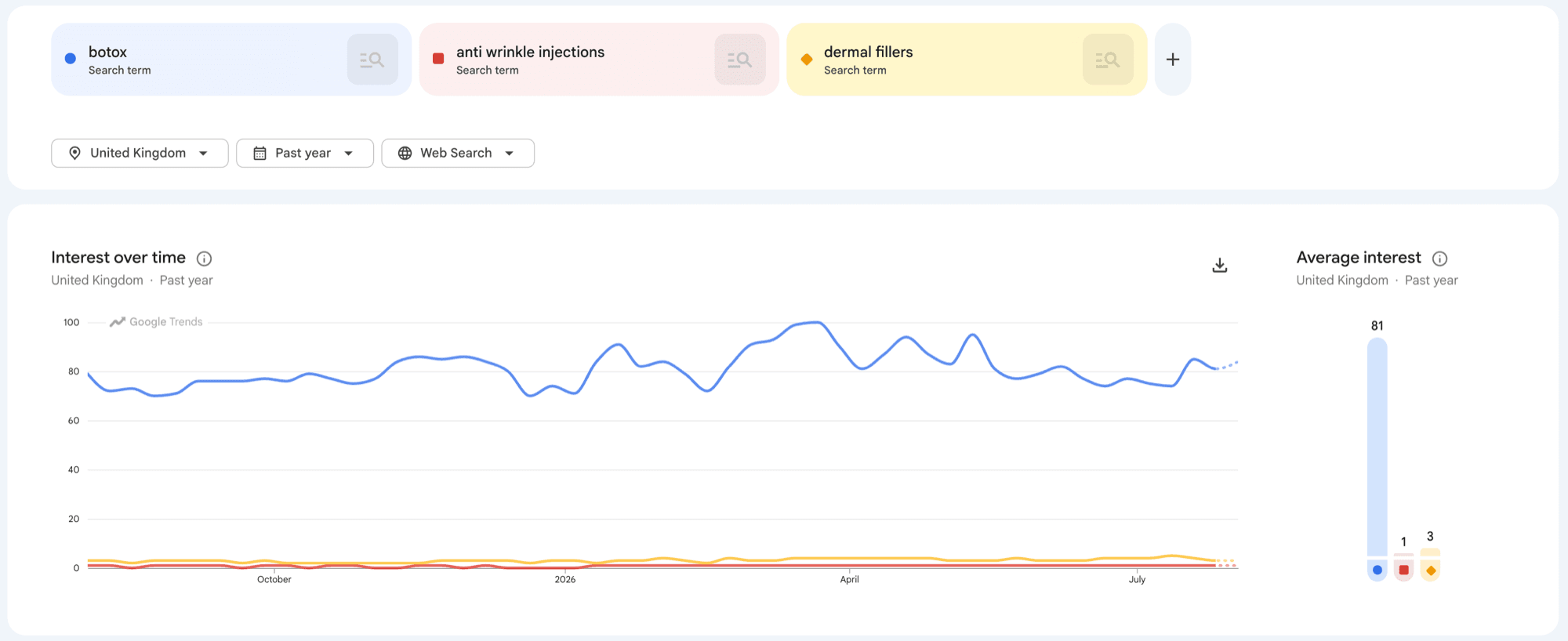
Over the last twelve months in the UK, botox averages an interest score of 81. Anti wrinkle injections — the phrase the entire sector recommends as the compliant substitute — averages 1. Dermal fillers averages 3.
The brand term never drops below about 70 across the whole year. Neither alternative ever rises above about 5.
That is an eighty-one-fold gap on the direct substitute, and it reframes the problem completely. You are not choosing between two ways of saying the same thing to the same audience. The search demand for your highest-margin treatment is locked behind a word you are not allowed to use — in your ads, in your keywords, or on the page you send the click to.
You can reproduce this in about thirty seconds on Google Trends. I would encourage you to, because it is the number that should drive your media plan and almost nobody publishes it.
Which means "just use the compliant terms" is not a strategy. It is a way of being compliant and invisible at the same time. The clinics that make paid search work do something different.
How do you build keyword structure when you cannot bid the brand name?
First, understand which rule is actually stopping you, because two different policies get conflated here constantly.
Google's trademark policy is not the obstacle. Google explicitly lists "using trademarks as keywords" among the things it does not restrict. Trademark complaints bite on ad text, not on keyword targeting.
The healthcare policy is the obstacle. Google restricts prescription drug terms "in ads, landing pages, and keywords", and gates keyword-targeting of those terms behind certification. Google does not publish the list of terms it treats as restricted, so whether a given keyword in your account is caught is an empirical question you answer in Policy Manager, not one anybody can answer from published policy. Be sceptical of anyone who tells you with certainty either way.
So where does the demand go? Four places, in descending order of how well they work:
Problem-level search. People do not only search for the product. They search for the thing the product fixes: forehead lines, frown lines, crow's feet, jawline definition, skin texture. This language is entirely nameable, it maps cleanly onto a consultation offer, and it is much less contested than the brand term because most clinics have never built campaigns around it.
Location and category intent. "Aesthetic clinic near me", "skin clinic [town]", "facial aesthetics [town]". Lower volume individually, high intent, and radius targeting keeps every click inside your catchment. This is what worked for the Birmingham clinic in our aesthetics case study — themed campaigns per treatment with tight radius targeting rather than one generic clinic campaign, which took them to a 6.2× return and a 58% reduction in cost per booked consultation over nine months.
The treatments you are allowed to name. Dermal fillers, lip filler, skin boosters, peels, microneedling, laser, HydraFacial. Real demand, no restriction, and patients who book one of these are exactly the patients who ask about the other thing at consultation. This is the compliant route to the conversation you actually want.
Brand and reputation terms. Your own clinic name, your practitioners' names. Cheap, high-converting, and frequently left unbid.
The automation problem nobody has flagged yet
Dynamic Search Ads generate headlines from the content of your website. If your site has a page naming a prescription-only medicine, DSAs will cheerfully write it into an advert you never approved. The same is true of automatically created assets and text customisation.
From September 2026, Google auto-upgrades campaigns using DSA, automatically created assets or campaign-level broad match to AI Max, converting dynamic search ads into responsive search ads with machine-generated text. In most verticals that is a performance question. In this one it is a compliance question, because you are handing copywriting to a system that has not read the CAP Code.
If you run DSAs, exclude your regulated-treatment URLs from the page feed. If you cannot do that cleanly, do not run them.
What can your landing page say?
Everything the ad cannot say still applies here, which is the single most expensive misunderstanding in this whole area. Google reviews the destination, not just the advert. Stripping the word from your headlines while leaving a /botox page live does not fix the disapproval, and the ASA takes the same view of your website that it takes of your ads.
CAP's guidance is unusually specific about where the medicine must not appear. Not on the homepage. Not in logos. Not in testimonials. Not in hover text, which in practice means your image alt attributes, title attributes and link tooltips. Not in the small print.
What you are allowed to do is offer the consultation, and treat the medicine as a possible outcome of it. The exact framing CAP permits is information about the product "only in the context of the product being offered as a possible treatment option following that consultation", presented in a way that is "balanced and factual" and consistent with the patient information leaflet. Two things follow:
"A consultation for lines and wrinkles" is safe. "A consultation for Botox" is not. The first advertises your service. The second advertises the medicine using the word consultation as a wrapper.
Prices for the medicine belong behind a click, not on the front page. CAP's position is that a price list naming the medicine may sit on an inner page reached from the consultation journey. It must never be on the homepage or in the advert.
There is a real legal basis for this rather than it being a polite fiction. Regulation 284 prohibits publishing an advertisement. Regulation 7(3) excludes from the definition of "advertisement" both factual reference material and price lists absent product claims, and correspondence answering a specific question about a medicinal product. A one-to-one clinical conversation is not publication. MHRA's Blue Guide Appendix 6 governs exactly this scenario and exists to help providers promote their services without promoting specific medicines.
Landing page compliance checklist
- ✓No prescription-only medicine named anywhere on the page, including alt text, title attributes, meta description and schema markup
- ✓The offer is the consultation, described as a clinical assessment rather than a booking for a specific product
- ✓No guaranteed outcomes, no 'completely safe', no 'no side effects', no 'painless'
- ✓No countdown timers, no false scarcity, no time-limited pricing on regulated treatments
- ✓Full legal business name, trading address and company number visible
- ✓Named practitioners with qualifications you can evidence if asked
- ✓Transparent consultation fee, and any deposit, stated before the enquiry form
- ✓Prices shown in the ad match the prices shown in the booking journey
- ✓Cancellation, refund, complaints and privacy information reachable from the page
- ✓Information on consent, aftercare and potential risks
- ✓Before-and-after images only for non-POM treatments, with signed and dated proof on file
What do the ASA rules mean for photos, offers and targeting?
Before-and-after photos
For a prescription-only treatment they are prohibited. The ASA's position is that before-and-after imagery of a POM is very likely to be seen as an implied advert for it, even with no claims attached.
For everything else they are permitted with conditions that most clinics do not meet. You must hold signed and dated proof that the photographs are genuine and have not been digitally altered. Enhancement of the treated area is prohibited, and the examples the ASA gives are exactly what clinics do by reflex: smoothing skin in a filler photo, concealer in an acne treatment photo. A disclaimer does not fix a filter. Keep a record of any production techniques used.
Time-limited offers
On a prescription-only treatment, never. The ASA's wording is that you must not include it in any kind of promotion, price or prize.
On other cosmetic treatments, a genuine offer is allowed but pressure is not. "Hurry, offer must end midnight this Friday" was ruled against. So was a 24-hour promotion, and a "2 days REMAINING" countdown on laser eye surgery, and a Black Friday breast surgery campaign that created a fear of missing out. Archive expired offer pages rather than leaving them live.
Under-18s
Two separate instruments get conflated here, so it is worth separating them.
The Botulinum Toxin and Cosmetic Fillers (Children) Act 2021 makes it an offence in England to administer toxin or filler to someone under 18 for cosmetic purposes, and a separate offence for a business owner to arrange it. That catches your booking process, not your marketing, and carries an unlimited fine.
The advertising restriction is CAP Code rule 12.25, and it has a number attached: ads for cosmetic interventions must not appear in media where under-18s make up 25% or more of the audience. That maps directly onto your platform settings. Set an 18+ age floor on paid social, review placement reports on Display, and check the audience profile of any influencer you work with.
Testimonials
A testimonial that names the medicine is itself an advert for the medicine. CAP lists testimonials alongside logos and hover text as places the POM must not appear. Rule 12.18 separately prohibits using health professionals or celebrities to endorse medicines, which rules out the practitioner-endorsement content that performs well everywhere else.
Where Google and Meta now disagree
Clinics tend to assume the platforms are broadly interchangeable on compliance. They are not, and they have diverged further recently.
The same clinic, two different rulebooks
Google Ads
- Opened a UK route in July 2025 for certified telemedicine providers to promote prescription drug services — though still never the drug name
- Prohibits platelet rich plasma outright under speculative and experimental treatments
- Restricts prescription drug terms in keywords as well as ads and landing pages
- Blocks advertiser-curated audiences for injectables: no Customer Match, no remarketing lists, no lookalikes
Meta
- No UK route at all — prescription drug advertising is limited to the US, Canada and New Zealand
- Permits promoting telehealth services generally, but never the medicine
- Personal attributes policy bans copy that addresses the reader's body, which catches most aesthetics ad copy
- Mandatory 18+ targeting on all cosmetic procedure and weight-loss advertising
The Meta copy rule deserves its own note because it is unusually easy to get wrong and Meta's own examples happen to be about wrinkles. You may describe the treatment. You may not address the reader's body.
✅ "Our new lotion and creams fight wrinkles like never before!" ❌ "Ready to upgrade your skin to look younger?"
"You" is not banned. "Your wrinkles" is. The distinction is whether the ad asserts or implies something about the person seeing it, and a body-focused question is the fastest way to trip it.
And the point underneath all of this: platform approval is not a compliance defence. Google may well approve "wrinkle-relaxing injections" because it is not on Google's restricted terms list. The ASA has named that exact phrase as prohibited. An advert can sail through review and still breach UK law, and it is the ASA and MHRA, not Google, who decide whether you have broken it.
Do these rules apply to organic social posts?
Yes, in full. This is where clinics leak most of their risk, because the advertising rules do not distinguish between money you spent and money you did not.
CAP's enforcement notice states that it applies to "all promotion of botulinum toxin injections to UK consumers on social media platforms", including "paid-for ads, non-paid-for marketing posts on your or others' pages and influencer marketing". The ASA has been blunter elsewhere: customer selfies and photos "fresh off the needle" are still ads. If a UK advertiser reposts something, they become responsible for its content.
What you can post: the clinic, the premises, the team, their qualifications and registrations; non-POM treatments by name; consultations for lines and wrinkles; skin health education; reviews that name no medicine.
What you cannot post: any brand or generic name for the toxin; the coinages and hashtags; before-and-afters of toxin results; prices attached to it; it as a competition prize or in a package; any endorsement of it by a practitioner or a celebrity; and reposts of anyone else doing those things.
What happens the day your account gets suspended?
This is the highest-intent moment a clinic owner ever has, and it is the moment most likely to be made permanently worse by acting on instinct.
The following is a representative recovery, assembled from how these cases actually run rather than a single client account.
A clinic advertising skin treatments, fillers and injectables launches a new promotional landing page. Shortly afterwards, an email arrives: account suspended for Unacceptable Business Practices. Every campaign stops at once.
The instinct is to edit the ads and resubmit. That instinct is what ends accounts.
An audit of the account above found five things contributing to it being read as high risk, and only the first is the one people expect:
- Direct promotion of a prescription-only medicine. "Botox from £99", "Book Botox online", "Three areas of Botox special offer" — in the ads and on the landing page.
- Claims beyond the evidence. "Guaranteed wrinkle-free results", "Look ten years younger instantly", "Completely safe with no side effects".
- Inconsistent pricing. An ad promoting treatment "from £99" against a booking journey showing a higher minimum plus a consultation deposit.
- Thin business information. No clear legal entity, no permanent address, no verifiable practitioner qualifications, no cancellation or complaints procedure.
- Prohibited audience targeting. Customer Match, website remarketing lists and audience expansion running on injectable campaigns — which Google does not permit for sensitive health services at all.
That fifth one is worth pausing on, because almost nobody knows it. Google classifies injections and invasive cosmetic procedures as sensitive health content, and advertisers in that category cannot use advertiser-curated audiences: no Customer Match, no remarketing lists built from treatment pages, no lookalikes, no audience expansion. Predefined Google audiences and location targeting are still available. If your agency built a remarketing list off your injectables pages, that is a policy violation sitting quietly in your account right now.
The recovery, in ten days
- 1
Days 1–2: audit before touching anything
Every ad, the policy history, all landing pages and final URLs, tracking templates and redirects, audiences, linked manager accounts, billing ownership, verification status and change history. Also check the site for compromised code or redirects serving different content to crawlers.
- 2
Days 2–4: fix the destination, not just the ads
Reframe the journey around a clinician-led consultation for lines and wrinkles. Remove guaranteed and instant-result claims, risk-free language, misleading before-and-afters and false scarcity. Add the full legal identity, verified practitioner profiles, transparent fees, and consent, aftercare and complaints information.
- 3
Day 4: submit one appeal
One. Acknowledge the problems rather than claiming a mistake, list the affected URLs, state exactly what changed, and attach the evidence. Duplicate appeals slow the review down.
- 4
Day 8: reinstated
Four business days after the appeal. Google's guidance says a specialist normally responds within three to five business days, which is a response time and not a guarantee of reinstatement.
- 5
Days 8–10: relaunch slowly
Tightly controlled Search only at first, with the prohibited audiences removed and every ad matched to a compliant page. Re-review of an edited ad typically takes 24 to 48 hours.
The appeal itself is worth quoting, because the tone is the thing most people get wrong:
Following a complete review of the account and destination, we identified several areas where our advertising and website did not provide sufficient clarity or comply with healthcare advertising requirements. We have removed direct promotion of prescription-only medicines, corrected pricing and business information, removed unsupported outcome and safety claims, removed restricted audience targeting and rebuilt the relevant landing pages. We have included evidence of the changes and respectfully request a new review of the account.
No protest. No claim that Google made a mistake. A list of what was wrong and what was fixed.
Two practical limits to know before you start. Each ad is limited to three appeals, and you should wait at least 24 hours between them or they get marked as duplicates. At account level you have six months to appeal, and since 21 July 2026 you can no longer appeal in-account for policy decisions made more than six months prior — those have to go through support.
The account in this example was not recovered through a loophole or a clever appeal. It was recovered by making the ads, the website, the business identity, the targeting and the evidence all tell the same compliant story.
Approved and high-risk ad copy, side by side
Nothing can be guaranteed approval in isolation, because Google reviews the landing page, assets, targeting, business details and account history alongside the ad. These assume a UK adult audience, substantiated claims, a compliant destination and genuine credentials.
Lines and wrinkles
| Copy | |
|---|---|
| ✅ Lower risk | Lines & Wrinkles Consultation / Clinician-Led Aesthetic Care / Discuss your concerns, suitability and available options at a private consultation. |
| ❌ High risk | Botox £99 – Book Today / Freeze Wrinkles Instantly / Guaranteed smooth skin with three areas of Botox. Limited appointments. |
The second names a prescription-only medicine, attaches a price to it, uses area-based pricing and guarantees an outcome. Four breaches in two headlines.
Outcomes
| Copy | |
|---|---|
| ✅ Lower risk | Personalised Treatment Plans / Explore Your Available Options / Individual recommendations following a consultation. Results and suitability vary. |
| ❌ High risk | Guaranteed Wrinkle-Free Skin / Look 10 Years Younger Today / Permanent results in one appointment or your money back. |
Safety
| Copy | |
|---|---|
| ✅ Lower risk | Clinician-Led Aesthetic Care / Consultation & Aftercare / Suitability, potential risks and aftercare are discussed before treatment. |
| ❌ High risk | 100% Safe Injections / Zero Risk or Side Effects / Completely painless treatments with no downtime and no complications. |
Dermal fillers
| Copy | |
|---|---|
| ✅ Lower risk | Dermal Filler Consultations / Individual Treatment Planning / Book an assessment to discuss your goals, suitability, treatment and aftercare. |
| ❌ High risk | Get Huge Lips in 20 Minutes / Instant Perfect Pout / No consultation needed. Walk in today and completely transform your lips. |
Body image
| Copy | |
|---|---|
| ✅ Lower risk | Subtle, Individual Results / A Consultation Built Around You / Explore treatment options based on your preferences and clinical suitability. |
| ❌ High risk | Fix Your Ugly Lips Today / Get the Perfect Face / Stop feeling embarrassed by your appearance. Become confident and attractive. |
Reputation
| Copy | |
|---|---|
| ✅ Lower risk | Meet Our Practitioners / View Clinic Information / Learn about our practitioners, verified qualifications and consultation process. |
| ❌ High risk | London's No.1 Botox Clinic / The UK's Best Injectors / Award-winning specialists offering better results than every other clinic. |
So what should an aesthetic clinic actually run?
Sell the consultation, compete where you are allowed to compete, and fix the destination before you spend anything on traffic.
The build order that works
- 1
Fix the website first
Every pound of traffic sent to a non-compliant page is a pound at risk. Scrub the medicine from every surface including alt text and schema, add the business identity and practitioner credentials, publish honest pricing. This is also the cheapest conversion work you will ever do.
- 2
Track consultations, not clicks
Call tracking, form tracking and booking-system events wired together so you can see cost per booked consultation by treatment and keyword. Without this you cannot tell a compliant campaign that works from one that does not. Most clinic enquiries arrive by phone, so call tracking is not optional.
- 3
Launch tight Search campaigns only
Themed per treatment, radius targeted, with brand names as negatives and no advertiser-curated audiences. Separate the treatments you may name from the consultation campaigns.
- 4
Qualify in the ad, not in the clinic
Honest pricing bands and who a treatment is and is not for, in the ad copy and on the page. This filters price-shoppers before they cost you a consultation slot and it lifts show-up rates.
- 5
Expand only once the cost per consultation is stable
Roughly ninety days. Then consider Performance Max or Demand Gen with the same compliance constraints applied to every asset, and remember automated campaign types generate copy you did not write.
The honest commercial picture: this is more expensive and slower than the version where you bid on the brand name, because you are competing for a smaller pool of nameable demand. Anyone telling you otherwise is selling something. What you get in exchange is an account that does not disappear overnight, and a patient who arrives having already read what the treatment involves.
That is roughly what happened with the Birmingham clinic: treatment-themed campaigns instead of generic ones, tracking wired in before any scaling, and qualification moved up front into the ads and landing pages. Over nine months it produced a 6.2× return, a 58% reduction in cost per booked consultation and a 68% show-up rate. All figures from the clinic's own ad account, call tracking and booking system.
Sources
Primary sources only. Where the regulators disagree with each other, that is noted above rather than resolved.
- Human Medicines Regulations 2012, regulation 284 — the prohibition
- Regulation 303 — penalties
- Regulation 7 — the definition of "advertisement" and its exclusions
- ASA — Botulinum toxin (Botox) products
- ASA — Botox frequently asked questions
- CAP Bitesize — Botox and non-surgical cosmetic interventions
- CAP — Prescription-only medicines on websites
- ASA — Prescription for compliance: POMs and the Code
- ASA ruling — Valterous Ltd t/a Therapie Clinic, 18 December 2024
- CAP enforcement notice — advertising Botox on social media
- ASA — Weight-loss prescription-only medicines enforcement report
- MHRA — Advertise your medicines
- MHRA Blue Guide, Appendix 6
- Google Ads — Healthcare and medicines policy
- Google Ads — Speculative and experimental medical treatments
- Google Ads — Circumventing systems
- Google Ads — Personalised advertising policy
- Google Ads — About suspended accounts
- Meta — Privacy violations and personal attributes
- Zargaran D. et al., analysis of advertising compliance across 233 London aesthetic clinics, Journal of Cosmetic Dermatology
Related guides
- How to choose a Google Ads agency in the UK — the questions that surface whether an agency knows your regulatory environment
- Why your Google Ads search terms report is missing data — essential when your negative keyword list is doing compliance work
- How to track phone calls from Google Ads in GA4 — most clinic enquiries arrive by phone
- How much should a small business spend on Google Ads in the UK? — budget context for a constrained keyword pool
- What is a good ROAS in Google Ads? — 2026 UK benchmarks
Frequently asked questions
Advertising Botox in the UK: FAQ
Can you advertise Botox on Google Ads in the UK?
No. Botox is a brand of botulinum toxin, which is a prescription-only medicine in the UK. Regulation 284 of the Human Medicines Regulations 2012 says a person may not publish an advertisement that is likely to lead to the use of a prescription only medicine. That covers your ad copy, your keywords and the landing page the ad points to. Google's own Healthcare and medicines policy separately restricts prescription drug terms in ads, landing pages and keywords outside the US, Canada and New Zealand. You can advertise a consultation for lines and wrinkles instead.
Is it legal to say 'anti-wrinkle injections' in an advert?
It depends on what else your clinic offers, which is why the sector disagrees about it. If you genuinely offer non-prescription injectable treatments alongside prescription ones, it can work as a collective term. If you only offer botulinum toxin, the ASA treats it as an implied advert for a prescription-only medicine and it breaches CAP Code rule 12.12. Attaching a price that relates only to the toxin treatment turns it into a breach either way.
Can I say 'wrinkle-relaxing injections' instead?
No. This is the phrase most clinics reach for and it is explicitly prohibited. CAP's enforcement notice tells advertisers not to substitute direct references to prescription-only medicines with indirect phrases that can only refer to one, and names wrinkle relaxing injections as its example. The word relaxing is understood as a reference to botulinum toxin, so it is treated as indirect promotion and is just as much of a problem as saying Botox.
Can I use the generic term 'botulinum toxin' rather than a brand name?
No. The ASA has stated that naming a prescription-only medicine is a problem whether you use a brand name like Botox or the generic form botulinum toxin. The restriction is on advertising the medicine, not on advertising a particular trademark, so switching to the generic name changes nothing.
Can I bid on 'botox' as a keyword if the word never appears in my ad?
Trademark law is not the obstacle here. Google explicitly does not restrict the use of trademarks as keywords. The healthcare policy is the obstacle: Google restricts prescription drug terms in ads, landing pages and keywords, and gates keyword-targeting of those terms behind certification. Google does not publish the list of terms it treats as restricted, so whether your specific keywords are gated is something you check in Policy Manager rather than something anyone can tell you from published policy.
Why was my Botox ad disapproved on Google Ads?
Most commonly because the ad text, an asset or the landing page named a prescription-only medicine. Google reviews the destination as well as the ad, so removing the word from your headlines while leaving a Botox page, a price list or a treatment menu naming it will not clear the disapproval. Sitelinks, callouts, structured snippets and automatically created assets are all reviewed too, and dynamic search ads generate headlines from your site content, which can reintroduce a banned term you never wrote.
Can a Google Ads account be suspended for advertising Botox?
Yes, and the fastest route there is trying to get around a disapproval. Repeatedly resubmitting reworded versions of a disapproved ad, or spinning up a new domain or account to keep running it, falls under Google's circumventing systems policy. That carries suspension on detection without prior warning and a permanent ban from advertising. The safe sequence is to fix the violation properly, then submit one appeal.
Can aesthetic clinics use remarketing and Customer Match on Google Ads?
Not for injectables. Google classifies injections and invasive cosmetic procedures as sensitive health content, and advertisers promoting sensitive health services cannot use advertiser-curated audiences. That rules out Customer Match, website remarketing lists built from treatment pages, lookalike segments and audience expansion. Predefined Google audiences and location targeting remain available.
Can I use before-and-after photos in aesthetics advertising?
Not for prescription-only treatments. The ASA treats before-and-after imagery of a prescription-only product as an implied advert for that product even with no accompanying claims, which breaches rule 12.12. For non-prescription treatments they are permitted, but you must hold signed and dated proof the photographs are genuine and unaltered, and a disclaimer does not cure a filter or a retouched image.
Can I run time-limited offers on aesthetic treatments?
Not on prescription-only treatments at all, where the ASA's position is that you must not include them in any kind of promotion, price or prize. For other cosmetic treatments a genuine offer is allowed, but it must not pressure people into a rushed decision. Countdown clocks and claims like 'hurry, offer must end Friday' have been ruled against, and expired offer pages should be archived rather than left live.
Qwestyon is a UK marketing agency that runs Google Ads for clinics and other businesses operating under real regulatory constraints. This article is compliance-aware marketing guidance, not legal advice — if you need a definitive position on your own advertising, take it to the ASA's Copy Advice team or a regulatory solicitor. If you want a second opinion on your account, get in touch.
Written by
Adam Rodell
Founder of Qwestyon, a Brighton-based digital marketing studio. Adam runs paid search and paid social for UK businesses and publishes original research on Generative Engine Optimisation, including the schema and AI-search audits on this blog.